
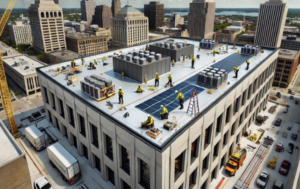
City government buildings are more than structures. They are service hubs where residents renew licenses, attend council meetings, visit courts, access public health programs, and rely on emergency operations when weather turns serious. When a flat roof fails, the impact is not limited to stains on ceiling tiles. Leaks shut down offices, damage records, disrupt services, create safety hazards, and trigger expensive emergency repairs that strain public budgets. Municipal facilities also face unique demands: high foot traffic, strict compliance standards, public accountability, and schedules that cannot pause because the roof is having a bad week.
Hiring a qualified commercial flat roofing company is one of the most practical, cost-protective moves a city can make. It converts roofing from a reactive fire drill into an asset-management strategy that supports continuity, stewardship, and long-term resilience. The difference shows up in fewer disruptions, better budgeting, and roofs that perform as intended through storms, heat, and time.
Why flat roofs require commercial-level expertise
Many city-owned buildings use low-slope or flat roofing systems because they work well for large footprints like city halls, public works buildings, libraries, recreation centers, police and fire facilities, and municipal courts. These systems are engineered assemblies, not just a surface. A flat roof can include insulation, vapor barriers, drainage design, membranes, flashings, penetrations for HVAC, and safety requirements for rooftop access. Each component affects lifespan and performance, and each has code and manufacturer requirements.
Commercial flat roofing contractors are trained to evaluate the full system, not only the obvious leak point. They understand how ponding water, wind uplift, thermal movement, and mechanical penetrations interact over time. This matters because municipal roofs are often asked to do more than keep water out. They may support rooftop equipment, solar, green roof sections, or reflective “cool roof” strategies tied to city sustainability goals. National city-focused policy work increasingly highlights rooftops and surfaces as part of resilience and climate response planning, including strategies that treat rooftops as infrastructure assets rather than afterthoughts. Federal Funding Opportunities That Support Resilient Infrastructure and Smart Surfaces National League of Cities
Protecting essential services and public safety
When a city roof leaks, it does not only damage drywall. Water can compromise electrical systems, create slip hazards, contaminate indoor air, and force closures that ripple through public life. A closed permitting office delays contractors and homeowners. A disrupted court schedule impacts the justice system. A compromised police or fire facility affects response readiness. Even a temporary relocation costs money and reduces service quality.
Commercial flat roofing companies are equipped to minimize operational disruption. They plan work phases, coordinate with facility managers, and implement safety controls suitable for public buildings. They are also more likely to provide documented maintenance programs that reduce the chance of unexpected failures. Modern public sector facilities management increasingly emphasizes preventive maintenance because it reduces emergencies, stabilizes costs, and improves service reliability. The Linchpin Role ICMA
Budget discipline through lifecycle planning, not emergency spending
Emergency roof work is almost always the most expensive way to maintain a facility. It is rushed, disruptive, and typically addresses symptoms rather than root causes. Cities also face the reality of deferred maintenance, where small issues become capital crises when neglected. A professional commercial roofer helps a city move from reactive spending to lifecycle planning with clearer timelines, more accurate cost projections, and better prioritization across the building portfolio.
This aligns with how local governments are working to handle deferred maintenance more strategically, using condition assessments and prioritization rather than waiting for failure. 5 steps to tackle runaway deferred maintenance for government facilities Route Fifty
It also complements the broader public conversation about maintenance backlogs across government buildings and the fiscal pressure they create over time. Deferred Maintenance and Repair at Civilian Agencies Congress.gov
For city leaders, the practical win is predictability. A commercial roofing partner can help build a multi-year plan that supports budget hearings, capital improvement planning, and transparent communication with residents about how tax dollars protect public assets.
Compliance, accountability, and procurement-ready documentation
City projects require a different level of documentation than private work. Procurement rules, prevailing wage requirements, certified payroll, insurance thresholds, safety plans, and reporting standards are part of doing business with municipalities. Commercial flat roofing companies that routinely work with public entities tend to be better prepared for this environment. They can supply submittals, product data, warranty documentation, inspection reports, and closeout packages that meet public sector expectations.
This matters because municipal governments operate within defined structures of public accountability and stewardship. The work must stand up to audits, public records requests, and long-term operational scrutiny. A properly documented roof project reduces disputes, supports warranty claims, and makes future maintenance easier to manage. A clear understanding of how municipal government functions and why public transparency matters is foundational to this approach. Municipal government National League of Cities
Resilience in extreme weather and changing risk profiles
Cities are planning for heavier rainfall, stronger wind events, and temperature extremes that stress building envelopes. Flat roofs are on the front line. Poor drainage design, aging membranes, and weak flashing details can turn a single storm into interior damage across multiple departments. Commercial roofing firms bring system-specific expertise for wind uplift resistance, drainage performance, edge securement, and details that hold up under repeated stress.
Building resilience is also increasingly connected to code modernization and the practical economics of avoiding loss. Public-facing government coverage has emphasized that updated building standards and resilience measures can pay off significantly for communities. More Resilient Buildings Will Save Lives and Money Governing
A commercial roofer can also help cities evaluate options like higher-performance membranes, insulation improvements, and assemblies designed for longer service life. Those upgrades can reduce risk, control long-term costs, and protect mission-critical spaces.
Energy performance and sustainability benefits that align with city priorities
City governments are often measured by how well they manage operational costs and environmental goals at the same time. Roof decisions directly influence both. Improved insulation, reflective membranes, and properly designed assemblies can reduce HVAC load, improve comfort, and support energy targets. Some roof strategies also align with municipal planning interests around “cool roofs” and surface-based heat mitigation.
Municipal planning organizations have highlighted how communities can encourage and implement cool roof strategies, including program and policy approaches relevant to cities. Cool Roofs: Incentive Programs MAPC
Commercial flat roofing companies can guide material selection and installation methods that support energy outcomes while still meeting durability requirements. This is especially useful for buildings with long operating hours, high occupancy, or sensitive indoor environments like clinics, community centers, and public safety facilities.
Better coordination with rooftop equipment and city operations
Municipal buildings often host a dense mix of rooftop equipment: HVAC units, exhaust fans, communications systems, and emergency power infrastructure. Every penetration and curb is a potential leak point if not detailed correctly. Commercial flat roofers are accustomed to coordinating with mechanical contractors, electricians, and facility teams so that roof details remain watertight as equipment is serviced or replaced.
They also understand how to schedule work around city operations. That includes traffic and parking impacts, public access routes, noise controls, and safety perimeters that keep residents and staff protected. This level of coordination is part of professional public facilities stewardship, which municipal organizations consistently treat as a core competency of effective local government management. Maintenance Standards for Parks and Facilities ICMA
Conclusion
City governments are guardians of public assets, public continuity, and public trust. A flat roof is not just a construction detail. It is protection for essential services, records, equipment, staff, and residents who depend on municipal buildings every day. Hiring a commercial flat roofing company turns roof work into a disciplined, documented, and resilient strategy that reduces emergencies, supports budgeting, strengthens compliance, and protects the spaces where government serves the community.
When cities treat rooftops as infrastructure and partner with commercial professionals who understand systems, documentation, safety, and long-term performance, they get more than a dry building. They get fewer disruptions, stronger stewardship, and a clearer path to maintaining the facilities that keep a city running.