
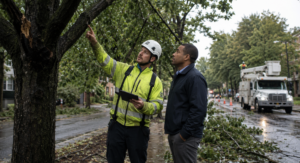
A severe storm can change a quiet city street in minutes. Heavy branches crash onto parked vehicles, mature trees block emergency routes, power lines become tangled in broken limbs, and public works crews suddenly face days of cleanup. While storms cannot be prevented, much of the tree-related damage they cause can be reduced through preparation.
That preparation often begins with one professional who may not receive much attention during municipal budget discussions: the arborist.
A qualified arborist can identify structural weaknesses, organize preventive maintenance, document hazardous trees, help protect public infrastructure, and guide city departments through storm response. For city governments working with limited personnel and tight budgets, this knowledge can mean the difference between an orderly response and an expensive emergency.
Trees are valuable public assets, but they must be managed with the same care given to roads, drainage systems, public buildings, and utilities. A city that treats tree maintenance as an occasional landscaping expense may eventually pay much more through emergency removals, property damage, blocked streets, overtime, lawsuits, and interrupted public services.
Municipal Trees Are Part of City Infrastructure 🌳
Trees along streets, in parks, around municipal buildings, and beside sidewalks are often viewed primarily as attractive features. In reality, they are part of a city’s working infrastructure.
The practice of urban forestry includes the planning, care, protection, and management of trees throughout cities and populated communities. Municipal arborists and urban foresters must consider public safety, tree health, transportation access, utilities, drainage, development, environmental conditions, and long-term maintenance.
A healthy tree can shade pavement, reduce heat around buildings, slow stormwater runoff, improve air quality, and add character to a neighborhood. A neglected tree with a damaged trunk, weak branch attachment, compromised root system, or advanced decay can become a costly hazard during high winds.
The challenge for city government is that these problems are not always visible to an untrained observer. A tree may appear green and healthy while decay is developing inside the trunk. Roots may have been damaged during road construction years earlier. Large limbs may be carrying too much weight over a roadway, playground, parking area, or public building.
An arborist evaluates trees as living structures. That perspective allows city leaders to address developing problems before wind, rain, ice, or saturated soil turns them into emergencies.
Preventive Inspections Reduce Expensive Surprises
Storm preparation should begin long before severe weather appears in the forecast. A municipal tree inspection program allows an arborist to locate trees that present the greatest risk and recommend work according to priority.
High-priority locations often include emergency routes, school zones, parks, heavily traveled streets, sidewalks, government buildings, utility corridors, and areas where large trees stand close to homes or businesses. The arborist can evaluate the condition of trunks, branches, roots, crowns, and surrounding soil while considering what could be damaged if part of the tree failed.
The goal is not to remove every large or mature tree. Responsible arboriculture focuses on managing risk while preserving healthy trees whenever practical. Corrective pruning, cable or support systems, soil improvements, pest management, crown reduction, and removal of deadwood may extend the safe life of a valuable tree.
The International Society of Arboriculture explains through its public education resource, TreesAreGood.org, that professional arborists have specialized knowledge for proper tree care and can safely address storm-damaged trees while reducing additional danger to property and people.
When a city needs local assistance with tree inspections, risk management, or municipal planning, searching for an experienced Arborist Near Me can help officials locate professional support before the next storm creates an urgent need.
Small Maintenance Costs Can Prevent Large Repair Bills
Preventive tree work requires funding, but emergency tree failure can create expenses across several city departments at the same time.
A large limb falling across a roadway may require police traffic control, public works equipment, emergency tree crews, barricades, debris hauling, and overtime. If the limb damages a traffic signal, streetlight, sidewalk, drainage structure, public vehicle, or utility line, repair costs can rise quickly. When a tree blocks access for an ambulance, fire engine, or utility crew, the consequences extend beyond the price of cleanup.
A single well-timed pruning operation or planned removal may prevent many of those expenses.
Research published by the U.S. Forest Service has examined the costs and benefits of municipal forests in several American cities. The research found that participating cities received measurable benefits from their tree-management investments, including environmental and economic value.
Those benefits are strongest when trees are managed throughout their life cycle. A city gains less from its urban canopy when young trees are planted without adequate watering, mature trees are ignored for decades, or hazardous trees are addressed only after residents report falling branches.
An arborist helps city leaders direct limited funds toward the work that carries the greatest public-safety value. Instead of responding randomly to complaints, the city can build a defensible maintenance schedule based on condition, location, consequences, and urgency.
An Arborist Improves Storm Response Planning ⚠️
Tree management should be included in a city’s broader emergency operations plan. During a severe storm, city departments need a clear process for receiving damage reports, prioritizing blocked routes, coordinating contractors, protecting utility crews, documenting debris, and communicating with residents.
The International City/County Management Association emphasizes the importance of practical emergency planning for local governments, including smaller communities that may not have a large emergency management department.
An arborist can contribute directly to that planning. Before storm season, the arborist can help identify vulnerable areas, prepare contractor contact lists, estimate equipment needs, and establish procedures for inspecting damaged trees. The arborist may also help train public works employees to recognize conditions that require immediate professional attention.
During recovery, priorities must be set carefully. A tree blocking access to a hospital, fire station, or major transportation route must be addressed before a damaged tree in a low-traffic area. Trees resting on electrical lines require coordination with the utility provider. Hanging branches over sidewalks or streets may require temporary closures until safe removal can be completed.
Without professional guidance, crews may remove trees unnecessarily, leave dangerous branches overhead, or make improper cuts that create future weaknesses. An arborist helps the city move quickly without allowing urgency to replace sound judgment.
Better Records Can Protect Municipal Budgets
Good documentation is one of the least visible but most valuable parts of municipal tree management.
A tree inventory can record species, approximate size, condition, maintenance history, geographic location, inspection date, and recommended work. Photographs and written risk assessments provide additional evidence that the city is monitoring its public trees and responding according to established priorities.
These records allow city leaders to prepare realistic maintenance budgets instead of waiting for emergency requests. They also help public works departments plan pruning cycles, track removals, schedule replacements, and identify neighborhoods where aging trees may fail at similar times.
Documentation becomes especially important after a declared disaster. FEMA debris-management guidance addresses vegetative debris such as branches, trunks, stumps, and whole trees. Municipalities seeking reimbursement may need organized records showing what work was performed, where it occurred, why it was necessary, and how debris was measured and removed.
An arborist can support that process by distinguishing between routine maintenance and emergency work, recording hazardous conditions, helping estimate debris, and documenting why particular removals were required for public safety.
Accurate information can also help a city defend its decisions. When residents object to a removal or question why one neighborhood received attention before another, officials can point to documented inspection criteria rather than relying on informal judgment.
Trees and Stormwater Must Be Managed Together
Tree management and stormwater management are closely connected. Trees intercept rain, slow the movement of water, improve soil conditions, and reduce the amount of runoff reaching streets and drainage systems.
The U.S. Environmental Protection Agency recognizes municipal street trees as an important part of public green infrastructure. Leaves, stems, and roots can slow rainfall, capture water, and reduce stormwater runoff while also providing shade, air-quality benefits, and other community advantages.
However, damaged or poorly selected trees can create drainage problems. Roots may interfere with infrastructure when trees are planted in spaces that are too small. Fallen leaves and branches may obstruct inlets. Saturated soil may weaken root stability, particularly when trees already have root damage or decay.
An arborist helps planners select appropriate species, planting locations, soil volumes, and maintenance methods. This creates a healthier canopy that can contribute to stormwater control without creating avoidable conflicts with sidewalks, streets, sewer lines, buildings, or overhead utilities.
That cooperation should begin during project design. Arborists can work with engineers, planners, developers, public works directors, and landscape architects before construction begins. Protecting roots during excavation is far less expensive than removing a mature tree several years after construction damage causes it to decline.
Public Works Crews Benefit From Arborist Coordination
Public works departments are often among the first municipal teams responding after severe weather. Crews clear streets, manage debris, repair infrastructure, place barricades, and restore access for emergency vehicles.
The American Public Works Association describes public works as an essential emergency response partner responsible for roadway clearance, traffic control, debris management, damage assessment, infrastructure repair, and restoration of public services.
An arborist makes those operations safer and more efficient. Tree failures can involve enormous weight, hidden tension, unstable trunks, suspended branches, and damaged root plates. A tree leaning against another tree or building may shift without warning. Cutting the wrong limb can release stored force and place workers in immediate danger.
The arborist can evaluate the safest order of work, determine whether specialized climbing or crane equipment is needed, and identify trees that should remain untouched until electrical or structural hazards are addressed.
This coordination prevents equipment from being sent to locations where it cannot be used effectively. It also reduces the chance that general crews will attempt work requiring advanced tree-care skills.
A Citywide Canopy Plan Builds Long-Term Resilience
Storm protection is not limited to pruning existing trees. Cities also need a long-term plan for replacing aging or damaged trees with species suited to local conditions.
Planting the same species throughout an entire neighborhood can create widespread vulnerability to insects, disease, drought, ice, or wind. Diversity helps prevent one threat from eliminating a large portion of the city’s canopy at once.
The National League of Cities has highlighted urban tree canopies as a tool for strengthening community resilience. Local leaders can use planning, policy, maintenance, and thoughtful development standards to protect and expand these public resources.
An arborist can help the city evaluate species diversity, age distribution, planting conditions, canopy gaps, maintenance needs, and storm vulnerability. This information supports smarter decisions about where new trees should be planted and which species are most likely to survive.
Young trees also require care. Planting ceremonies may attract attention, but watering, structural pruning, mulching, and early inspections determine whether those trees become durable public assets. An arborist ensures the city’s investment does not end when the tree enters the ground.
Conclusion
One arborist cannot stop a hurricane, thunderstorm, tornado, ice storm, or destructive wind event. That professional can, however, help a city government enter the storm with fewer known hazards, clearer priorities, stronger records, safer procedures, and a healthier urban forest.
The savings may come from a branch that never reaches a public vehicle, a tree that never blocks an ambulance route, a damaged trunk identified before it falls, or documentation that supports disaster reimbursement. These avoided costs rarely receive headlines because the emergency never happened.
That is the value of preventive arboriculture.
For city governments, hiring an arborist is not simply an investment in attractive streets and parks. It is a practical decision involving public safety, infrastructure protection, stormwater management, emergency preparedness, and responsible budgeting.
A city that cares for its trees before the wind begins is better prepared to protect its residents, its employees, and its financial resources when the next major storm arrives.